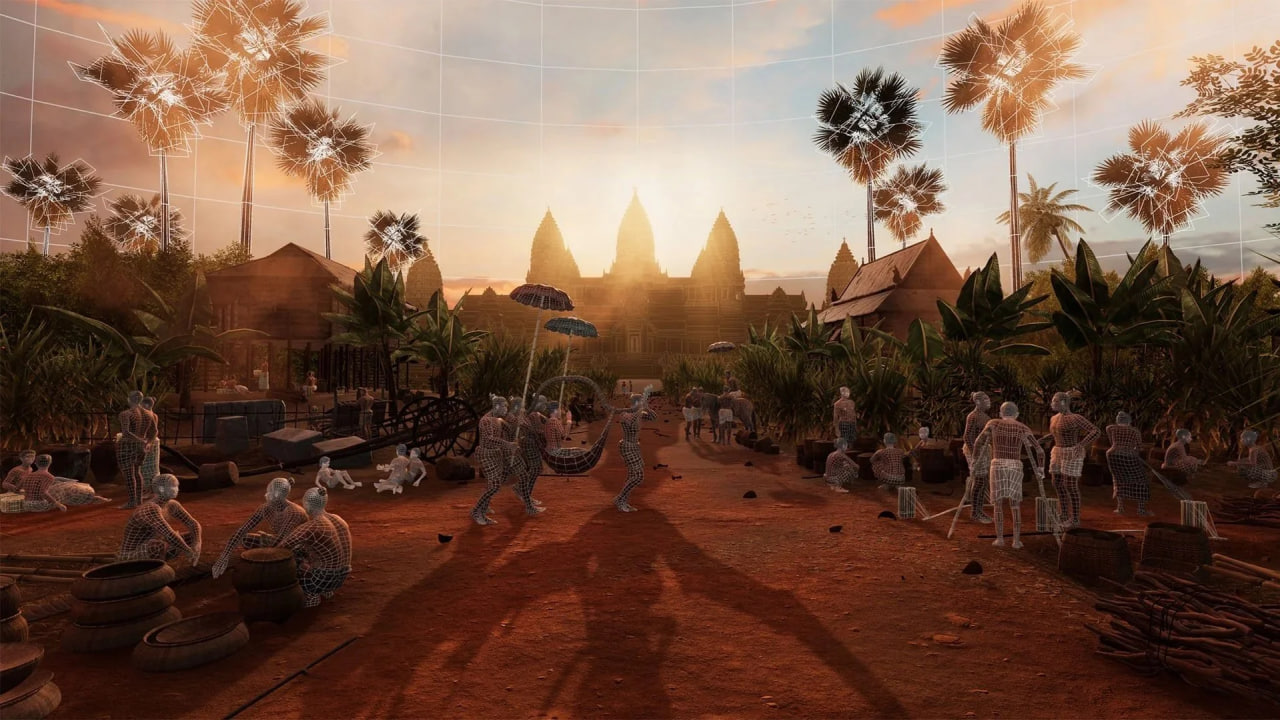
Most people know Angkor Wat, but the empire was actually a massive "hydraulic machine" that managed water on a scale never seen before. Here is the real story of how it worked and why it eventually broke.
More Than Just Temples
When you look at the massive stone towers of Angkor Wat, it is easy to think the Khmer Empire was just about religion. But actually, those temples were the heart of what archaeologists call a "hydraulic city." Recent laser mapping (LiDAR) has shown that Angkor was likely the largest pre-industrial city in the world, covering a space larger than modern-day New York. At its peak in the 13th century, between $700,000$ and $900,000$ people lived there, which is about the same as ancient Rome.
The Mastery of Water
The Khmer didn't just build pretty buildings; they were master engineers. The region has a brutal cycle of monsoon rains followed by months of drought. To survive, they built a giant system of reservoirs called "barays" and miles of canals. These weren't just for drinking water. They allowed farmers to grow three or four rice crops a year, which gave the empire the wealth to build all those famous temples.
- The Barays: Massive man-made lakes that held millions of gallons of water.
- Gravity-Fed Irrigation: They built the reservoirs on high ground so they could just let gravity pull the water down into the fields when needed.
- Cosmic Design: Even the moats around the temples had a job. They stabilized the groundwater to keep the heavy stone structures from sinking or shifting.
The God-Kings and the Devaraja Cult
The empire officially started in 802 AD when a prince named Jayavarman II stood on top of a mountain and declared himself a "Chakravartin" or universal ruler. He started the Devaraja cult, which basically said the king was a living god on earth. This gave the kings the power to command the massive labor needed to dig the canals and pile the stones.
Why It All Fell Apart
For a long time, people thought the empire just vanished after a Thai invasion in 1431. But it turns out it was much more complicated. Actually, the system was already failing a hundred years before that.
First, the climate changed. Around 1300, a "Little Ice Age" hit Southeast Asia. This brought decades of extreme drought followed by sudden, violent floods. The water system couldn't handle the swing. Silt and mud filled the canals, and the barays started to fail.
Second, religion changed. People started moving away from the "God-King" ideas and toward Theravada Buddhism. This new faith emphasized simplicity and equality. It meant the kings could no longer force hundreds of thousands of people to maintain the complex waterworks or build more temples.
The Legacy
The Khmer Empire didn't really disappear. The capital just moved south toward Phnom Penh to focus on trade instead of rice farming. But the engineering and art they left behind changed Southeast Asia forever. You can still see their influence in the language, court rituals, and architecture of modern Cambodia, Thailand, and Laos.